Africa has built its renewable energy story largely on water. Of the 70 GW of renewable capacity installed across the continent, more than 42 GW comes from hydropower — over 60% of total clean generation (IRENA). In a normal hydrological year, this works. The problem is that "normal" is becoming the exception.
The hydro thesis is breaking
Climate change is reshaping the inflows that African hydro fleets were designed around. Across Morocco, Gabon, Kenya, Zambia and Ghana, recent drought years have driven hydropower output materially below reference levels — in several cases to a fraction of normal generation. The pattern is not a one-off. Drought events are becoming more frequent and more severe across the continent, and they hit hardest in the markets that are most hydro-dependent: hydropower accounts for the majority or near-majority of installed capacity in several African systems, including Zambia, Gabon, Mozambique and the DRC.
When the rains fail, utilities scramble. The default response across the continent has become emergency thermal generation — diesel, heavy fuel oil, or imported gas — at generation costs that are routinely several times the price of solar. The position has worsened over the past year. Recurring tensions around the Strait of Hormuz, through which roughly a fifth of global oil flows and a substantial share of LNG cargoes transit, have pushed both oil and gas prices into a higher and more volatile band. For African systems that fill hydro shortfalls with imported fuel, the implication is direct: the cost of being short of clean baseload has gone up, and is unlikely to come down.
The deeper issue: this is not a temporary problem. It is the new operating reality of African power systems built around water assets in a warming climate. Capacity that was designed as baseload is increasingly behaving as variable-output generation, and the systems around it have not been redesigned to compensate.
Why floating solar is the natural complement
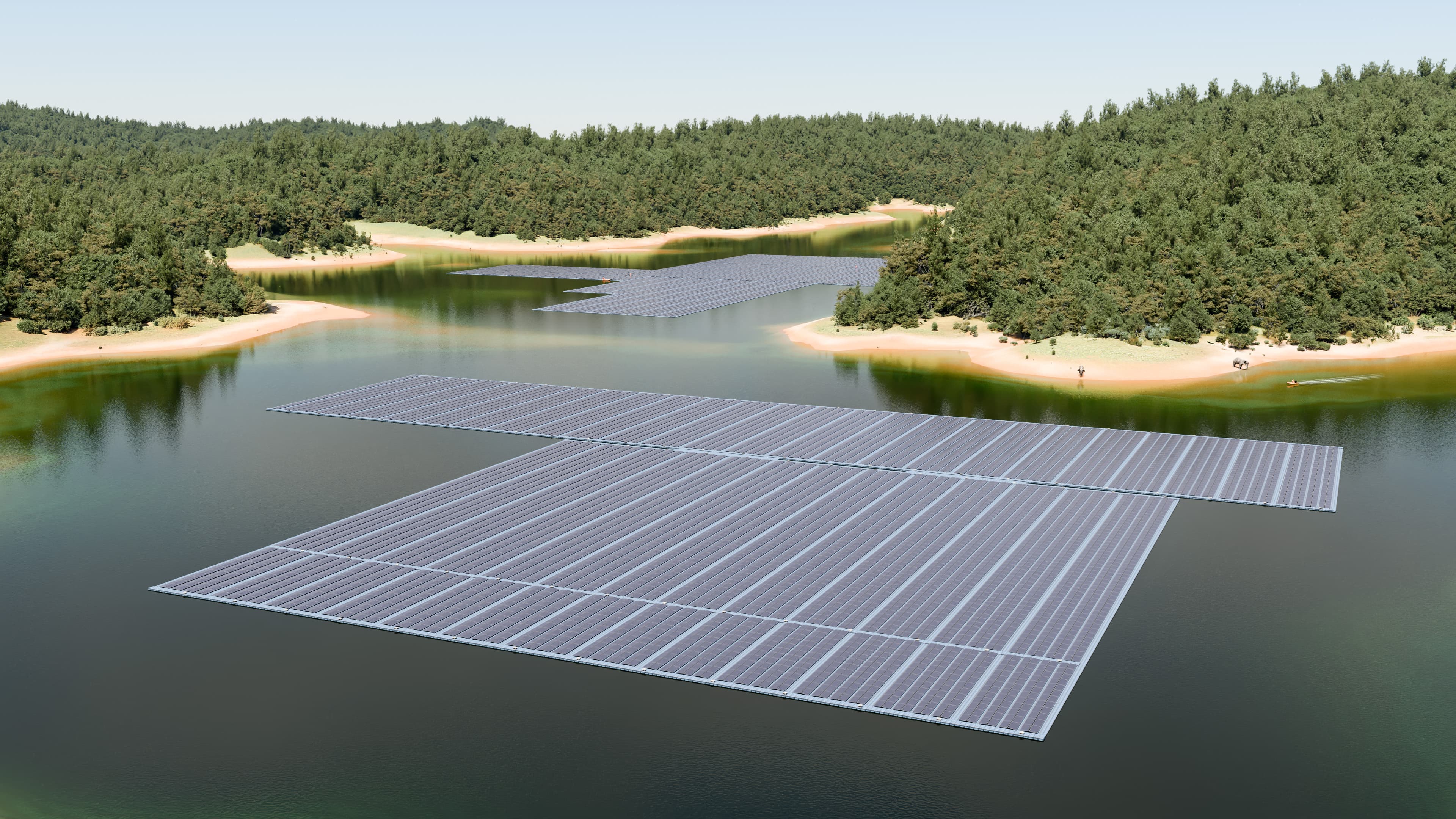
Floating photovoltaic (FPV) systems address this in a way no other technology does at scale. Three properties matter.
It generates exactly when hydro doesn't. In dry seasons, when reservoir inflows drop and hydro output falls, solar irradiance is at its highest. The two resources are negatively correlated across most African geographies. Where hydro is being run as constrained dispatch to manage shrinking reservoirs, FPV provides daytime energy that lets the operator preserve water for peak hours and the dry season. Hybridisation is not just additive — it changes how the underlying hydro asset can be operated.
It is more efficient on water than on land. The cooling effect of water on PV modules increases yield by 10 to 20% compared with ground-mounted systems without trackers. Combined with reduced soiling on water surfaces and a more stable thermal environment for module performance over the asset life, the energy delivered per installed MWp is materially higher.
It uses infrastructure that already exists. Hydropower reservoirs come with substations, transmission lines, dam access roads, and operations crews. The grid is sized for the hydro nameplate capacity, but during droughts that capacity is partially unused — meaning FPV can often be added without major grid reinforcement. In project finance terms, this is the difference between a bankable project and a stalled one.
Why Africa, and why now
There has been a quiet assumption that FPV is an Asian technology, suited to Asian conditions. The data argues otherwise. The Global Atlas of Marine Floating Solar PV Potential, based on a 40-year analysis of wind-speed and wave-height data, identifies Africa as one of the two continents most physically suited to FPV deployment, alongside Asia. African reservoirs, particularly those in the tropical belt, exhibit low average wind speeds and low wave heights — the two design constraints that drive mooring and structural costs. The technical case for African deployment is, if anything, stronger than for the markets where 5 GW of FPV is already operating.
The European Commission's Joint Research Centre has put a number on the upper bound. Covering just 1% of Africa's hydropower reservoir surface area with FPV would add approximately 50 GW of clean generation capacity — enough to triple the continent's currently installed solar PV base. Africa has 101,130 km² of available surface area across 724 assessed water bodies. The technical addressable market is not the constraint.
What has been the constraint is execution. Until now, African FPV has consisted of a handful of small projects — 13 MW in Morocco, 5 MW in Ghana — useful pilots, not investable platforms. The gap to bridge is not technological. It is the move from pilot to utility-scale, with the project structuring, technical due diligence, and stakeholder alignment that turn a feasibility study into a financial close.
The "vice versa": what FPV gives back to hydro
The hybridisation logic flows in both directions, and this is where the economics get interesting. When FPV is added to an operating reservoir, three things happen.
Water releases through the hydro turbines can be reduced during sunny hours, because solar is meeting demand. The water saved is held in the reservoir and dispatched later — at higher value — during peak hours, dry seasons, or grid-stress events. The hydro asset effectively becomes a longer-duration, more flexible, higher-revenue facility.
Evaporation losses fall. Floating modules shade the water surface and reduce direct evaporation, which in semi-arid catchments is non-trivial. Net inflow to the reservoir effectively rises.
The combined system delivers a more stable output profile than either resource alone. For a grid that is increasingly running on intermittent renewables and weakened hydro, this is exactly the kind of dispatchable, firm capacity that planners are short of.
The point is that FPV does not just sit on top of a hydro asset. It improves the underlying asset's operating economics. In a properly structured PPA, that uplift can — and should — be priced.
The path forward
Floating solar in Africa will not scale by itself. It needs developers with the local relationships to navigate concession structures, technical partners with proven track records of delivering at utility scale, and capital prepared to take development risk on a category that is new to the continent but mature globally. The investable opportunity is large; the execution challenge is to convert it.
At Green Energy Ventures, our 50 MWp project on Gabon's Tchimbélé reservoir, hybridised with the existing 69 MW hydropower plant and feeding into a system that supports two further downstream stations totalling 93 MW, is designed as the proof point for that thesis. The economics work — at a clean tariff materially below the cost of thermal generation in the country, and competitive with prevailing retail electricity prices. The technology works in tropical conditions. The only thing missing in Africa is scale, and that is what the next decade will deliver.
Sources
- IRENA renewable capacity data (2024)
- European Commission Joint Research Centre, FPV Africa potential study (2023)
- World Bank / SERIS Global FPV database
- National utility hydropower reports across Morocco, Gabon, Kenya, Zambia and Ghana
- Global Atlas of Marine Floating Solar PV Potential